

What Makes a Law Firm Website Different
A law firm website is not like a regular business website. The stakes are higher. The rules are stricter. And the people visiting your site are often stressed and looking for help fast.
Your website needs to do three things at once:
- ✓Build trust in seconds, people need to feel safe before they call a lawyer.
- ✓Follow the rules, every province has advertising rules for lawyers.
- ✓Capture leads, every visitor who leaves without contacting you is a missed case.
Most law firm websites fail at all three. They look outdated. They break advertising rules they do not know about. And they have no real way to capture leads.
This guide will show you exactly what your law firm website needs to get it right.
Law Society Advertising Rules You Need to Follow
In Canada, every province has a Law Society. And every Law Society has rules about what lawyers can say on their websites.
The rules vary by province, but here are the big ones that apply almost everywhere:
- ✓No misleading claims. You cannot say you are "the best lawyer in Toronto" unless you can prove it.
- ✓No guarantees. You cannot promise results. Saying "we win every case" is a problem.
- ✓Required disclaimers. Some provinces require disclaimers on testimonials or case results.
- ✓Truthful credentials. Only list certifications and specialties you actually have.
- ✓Client confidentiality. Never share client names or details without written consent.
The Law Society of Ontario, Law Society of British Columbia, and Barreau du Quebec all have their own specific guidelines. A web design company that works with law firms should know these rules.
If your current website has claims like "guaranteed results" or "best lawyer in the city," fix it now. It is not worth the risk.
The Pages Every Law Firm Website Needs
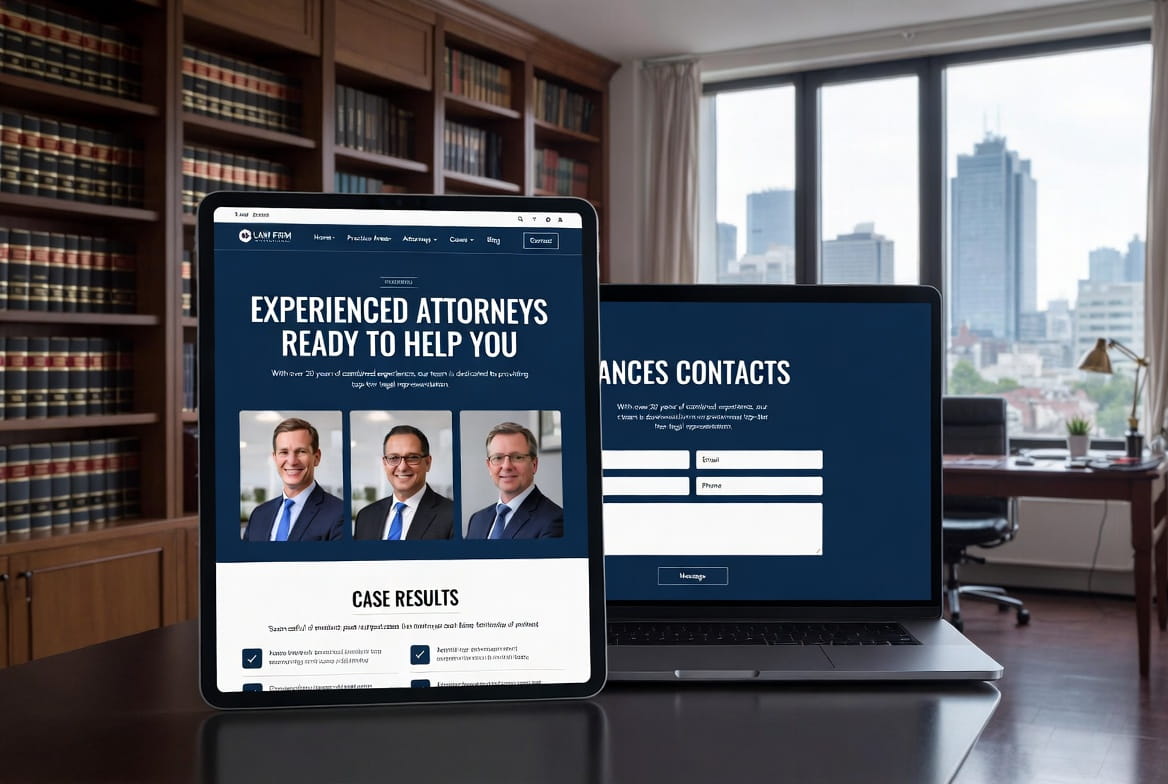
You do not need a massive website. You need the right pages, done well.
Homepage: This is your first impression. It should say what kind of law you practice, where you are located, and how to get in touch. Keep it simple. Keep it clear.
Practice area pages: One page for each area of law you handle. "Family Law in Vancouver" is way better for SEO than a single page that lists everything. Each page should explain what you do, who you help, and what the next step is.
About / Team page: People want to know who their lawyer is. Show real photos. List your credentials. Tell your story. This page builds trust more than any other.
Contact page: Make it easy. A short intake form, your phone number, your office address, and your hours. The fewer fields on the form, the more people will fill it out.
Testimonials / Results page: Social proof matters. If your Law Society allows it, show client reviews and case results with proper disclaimers.
Blog: Fresh content helps you rank on Google. Write about the questions your clients ask you every day. That is exactly what people are searching for.
CASL and PIPEDA: What Your Website Must Do
If you collect any personal information on your website, names, emails, phone numbers, you need to follow Canadian privacy law.
PIPEDA is Canada's federal privacy law. It says you must:
- ✓Tell people what information you collect and why.
- ✓Get their consent before collecting it.
- ✓Keep their data safe.
- ✓Let them access or delete their data if they ask.
CASL is Canada's anti-spam law. If you plan to send emails to leads from your website, you need explicit consent. That means a checkbox on your form that says something like "I agree to receive emails from [Firm Name]." Pre-checked boxes do not count.
This matters even more for law firms. Your clients trust you with sensitive information. If your website does not handle data properly, that is a liability.
A good web design company will build CASL and PIPEDA compliance into your site from day one. If they do not mention it, ask.
Trust Signals That Turn Visitors Into Clients
People looking for a lawyer are scared. They are dealing with a divorce, an injury, a criminal charge, or a business dispute. They need to trust you before they pick up the phone.
Here is how your website builds that trust:
- ✓Professional design. If your site looks cheap, people think your firm is cheap. First impressions matter.
- ✓Real photos. Use photos of your actual team and office. Not stock photos of fake lawyers shaking hands.
- ✓Credentials and awards. List your Law Society membership, years of experience, and any awards or recognitions.
- ✓Client reviews. Real reviews from real people. With proper disclaimers where required.
- ✓Secure site. An SSL certificate (the lock icon in the browser) tells visitors their data is safe.
- ✓Fast load time. A slow site makes people leave. And it hurts your Google ranking.
Every one of these trust signals can be built into your website. Most law firm sites are missing half of them.
Online Intake Forms: Capture Leads Without a Receptionist
Most law firms still rely on phone calls for new inquiries. That works during business hours. But what about evenings? Weekends? Holidays?
An online intake form lets potential clients reach you any time. They fill out a short form on your website. The information goes straight into your CRM. Your team gets notified right away.
Here is what a good law firm intake form looks like:
- ✓Name and contact info. Keep it short. Name, email, phone. That is enough to start.
- ✓Type of legal matter. A simple dropdown. Family law, personal injury, criminal defence, etc.
- ✓Brief description. One text box where they can explain their situation in a few sentences.
- ✓Consent checkbox. Required under CASL if you plan to follow up by email.
The form should be on every page of your site. Not hidden on a contact page. Make it easy for people to reach you no matter where they are on your site.
When the form connects to a CRM like GoHighLevel, your team can follow up in minutes instead of hours. That speed is often the difference between winning and losing a case.
How Much Does a Law Firm Website Cost in Canada?
A custom law firm website in Canada typically costs between $3,500 and $7,000 CAD. Larger firms with multiple practice areas and locations may invest $7,000 or more.
That price should include:
- ✓Custom design, not a template.
- ✓Mobile-friendly layout.
- ✓Practice area pages optimized for SEO.
- ✓Intake form connected to your CRM.
- ✓CASL and PIPEDA compliance.
- ✓Fast hosting and SSL certificate.
- ✓Basic on-page SEO setup.
Some agencies charge $15,000 or more for law firm websites. You do not need to spend that much to get a site that looks great and brings in clients.
There is also a growing alternative to the big upfront project fee. Instead of writing a $15,000 cheque and waiting, more firms are moving to a subscription: a small one-time setup to start the build, then a flat monthly fee for unlimited design and development. In practice that looks like $399 CAD to start, then $299/mo for unlimited change requests with a one to two business-day turnaround, month-to-month with no long-term contract.
The real question is not "how much does it cost?" It is "how many new clients will it bring in?" For a law firm, a single retained client typically covers many months of a plan like that. When one new matter can be worth thousands in fees, the website pays for itself many times over.
Want to know exactly what your law firm website would cost? We build custom websites for law firms across Canada. No templates. No guesswork.
Get a Website That Brings in Cases
Your website should be your firm's best referral source. It should bring in qualified leads while you focus on your cases.
At GrowToday, we build custom websites for law firms across Canada. Every site is fast, compliant, and wired into your CRM. We know the Law Society rules. We know CASL and PIPEDA. And we know how to build a site that turns visitors into consultations.
You start your build for a one-time $399 CAD, then $299/mo for unlimited design and development, no $15,000 upfront project fee. For most firms, one retained client covers many months of the plan. It is month-to-month, so you can pause or cancel anytime.
Ready to upgrade your law firm's website? Answer four quick questions to get started, and if we are a match you will get your GrowToday portal invite within one business day.
Ready to get started?
Answer four quick questions about your business. If we're a match, you'll get an invite to your GrowToday portal within 1 business day.
Get Started